
Marketing Consulting

ARGO / the design studio that drives marketing

Services

Marketing strategy planning support

Support across all 4Ps, including product strategy, communication strategy and long-term brand strategy

Marketing capability building support

In-house capability and IP infrastructure development, product development support

Business design

New business development support, strategy planning for existing businesses, market and competitor research, positioning design

Our proprietary programme ARGO

ARGO is a programme in which we work alongside you to design, implement and embed the machinery of marketing. Rather than proposing from the outside as an agency, we get inside the business and build the mechanism that drives marketing itself. “We have a marketing team, but all it does is manage campaigns.” “Our own people can't draw up the strategy.” Our job is to take organisations like these and get marketing running under its own power again.

ARGO is made up of the four phases A·R·G·O. Behind what looks like a simple flow sit the diagnostic, design and forward-deployment methods we have refined over ten years, which makes the programme hard to imitate.

A: Architect R: Reconstruct G: Generate O: Osmose

The problems we solve

  • Even with a marketing team, all that happens is executing and managing campaigns.
  • The people who can shape strategy and the people who can drive execution are separated inside the organisation.
  • Internal talent alone cannot draw up the strategy — or there is no marketing team at all.
  • You want to reform how marketing itself is done, and bring it in-house.
  • Return on investment stays invisible, and the same initiatives are repeated year after year.

A: Architect

[Design and frame the concept]

Most consultants stop at summarising industry trends and skimming the competition. What you actually need is to read the structure underneath: why your marketing function is not working right now.

ARGO always begins with a diagnosis of the function, before any strategy is written.
The Architect phase

Approach

Diagnostics

We diagnose the marketing function against our own set of elements and make visible where it has stalled.

GAP → ISSUE → OBJECTIVE design

We articulate the gap between the current and desired state as the issues to be cleared, and set the direction of the strategy in priority order.

Strategic Blueprint

We draw a 12 to 24 month picture of the whole strategy that the organisation can actually implement.
R: Reconstruct

[Rebuild and reassemble]

This is where the consultants who wrote the strategy walk away. But a strategy only means something once it becomes machinery that can be implemented. Reconstruct is the phase where we build the working tools your people can start using on Monday morning.

The Reconstruct phase

Approach

Workflow Reconstruction

We rebuild the flow of decision-making, approval, commissioning and validation, turning criteria that lived in individuals' heads into shared organisational knowledge.

Template Library

Briefs, proposals, KPI design documents — a set of formats optimised for your organisation.

Data Infrastructure design

We design where the data behind decisions comes from, how it is read and who uses it.

Organizational Role Design

Roles are redefined within the new machinery, including how external resources are brought in.

Proprietary solution

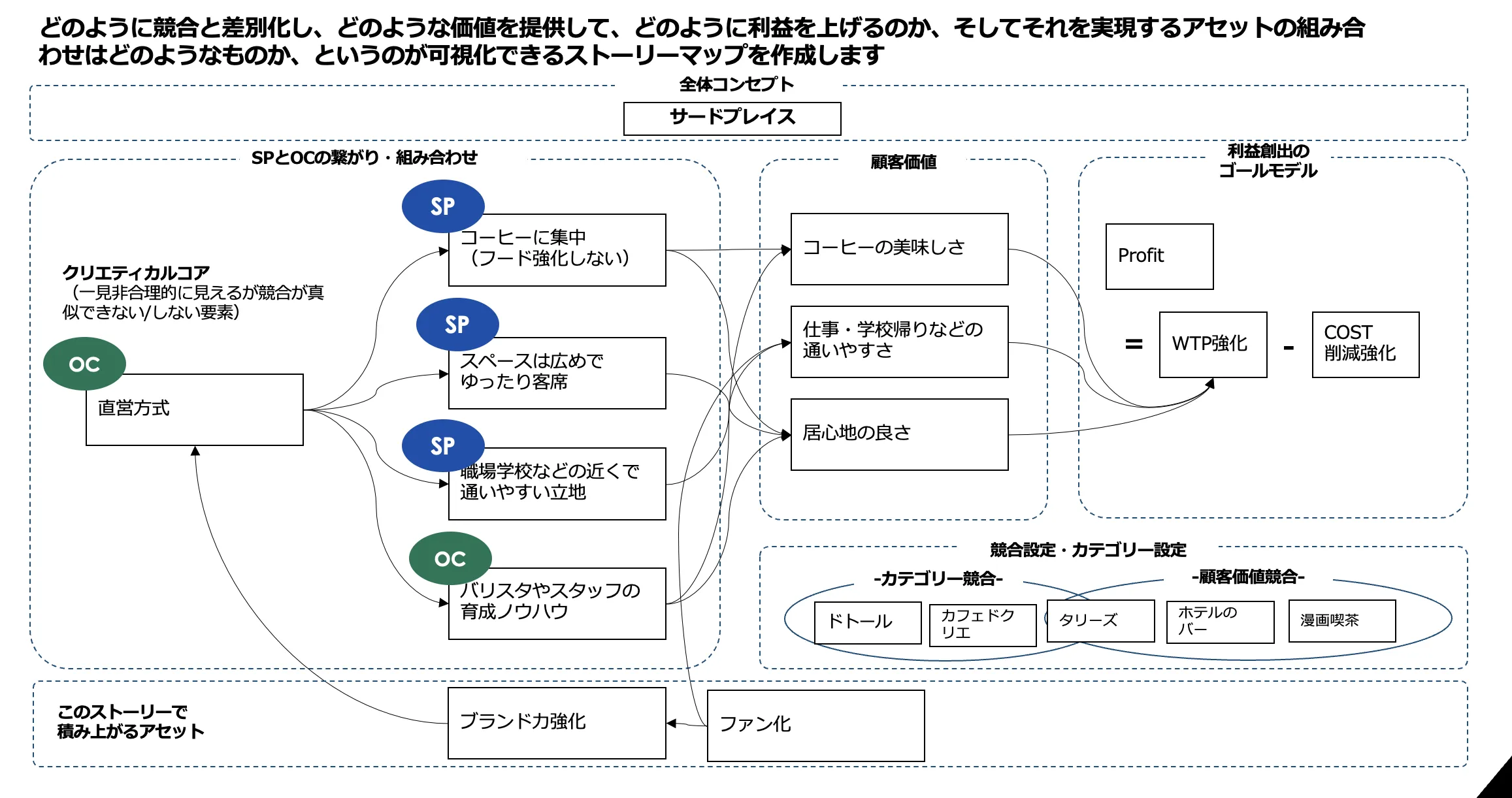
SP/OC Strategy Story Workshop

SP/OC Strategy Story Workshop

A training programme that draws on Professor Ken Kusunoki's Strategy as a Story (Hitotsubashi University) to surface the blind spots and pitfalls in your marketing, and what to do about them. We sort your strategic assets into SP (strategic positioning: doing something different from others) and OC (organisational capability and assets: having something different from others), then connect them as a line rather than a set of points, designing a coherent story that runs through to customer value and profit. The aim is differentiation that cannot be copied, and the accountability to explain why each initiative is necessary in terms of cause and effect.

  • STEP 1: Articulating customer value
  • STEP 2: Workshop to build a competitive strategy story hypothesis
  • STEP 3: Session presenting the completed competitive story
  • A free follow-up session is held one to three months afterwards.

G: Generate

[Generate and set in motion]

Strategy and machinery may as well not exist until they start moving on the ground. Generate is the phase where 107 Design people physically join your team, closing the gap between design and reality by hand and actually driving marketing forward.

We run this as our own forward-deployment model, which we call FDM (Forward Deployed Marketer).

The Generate phase

Approach

FDM Assignment (forward-deployed marketing support)

A senior marketer becomes one of your own people, improving processes on the ground in real time and committing to results rather than deliverables.
The improvement process is documented and left behind as your own manuals and knowledge.

Proprietary solution

WATERWHEEL MODEL

WATERWHEEL MODEL

Our own research and test-marketing solution for minimising the market risk that comes with new products, new audiences and new markets. Social advertising drives people to waterwheel landing pages built around a variety of angles, and prospects are gathered into LINE, accumulating a list of future customers as an asset. Where conventional web research captures the past and present, the WATERWHEEL MODEL tests future moves: what approach actually makes people act. It develops category entry points (CEPs) and runs test marketing at the same time, turning marketing from a cost into an investment.

  • Reduces risk up front in highly uncertain areas such as new product and new audience combinations
  • Turns future customers into an asset, and budget from a cost into an investment
  • A practical framework for building category entry points (CEPs)

O: Osmose

[Permeate and gradually take hold]

The final phase prepares 107 Design to quietly step away. The marketing function operates as part of the organisation and runs without outside help: that is what a completed ARGO looks like. Many firms have no exit design at all, and the relationship becomes a dependency that cannot be broken.

What ARGO leaves behind is a self-sustaining marketing function.

The Osmose phase

Approach

Internal Training Program

We codify the marketing machinery we have built, document it and embed it through training so your own people can run it.

Advisory

After the engagement ends we remain available as a sounding board, providing aftercare when it is needed.

CASE STUDIES

View all works

SPEAK TO US

Our staff will introduce relevant case studies in a meeting and, based on what we hear from you, propose the execution flow that fits you best.

Contact